Español




 0


Unique and special collectible fossils
Unique and special collectible minerals
Unique and special collectible fossils
Unique and special collectible minerals
 100% SECURE PAYMENT
Credit card or PayPal
 SHIPPING
Estimated time 7 to 10 days
 RETURNS
See our return policy

Guarantee safe & secure checkout
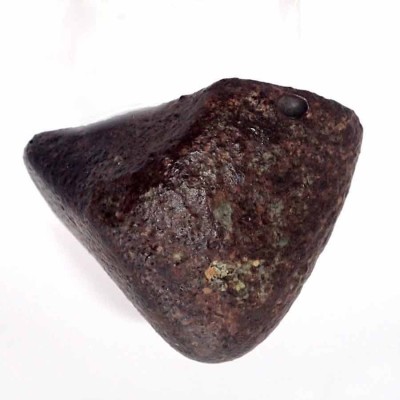
Spectacular complete and oriented chondrite; an oriented meteorite is one that maintains a stable trajectory during its fall, without rotating, allowing aerodynamic forces to melt and shape its surface uniformly. They usually have a conical or "shield" shape, with a smooth front face and a sharp edge, the result of intense ablation.
Weighs 380 grams. Measures approximately 9.7 x 7 x 4.5 cm. Main minerals: olivine, hypersthene, Ni-Fe.
*Stony meteorites comprise a wide variety of types, with ordinary chondrites being the most abundant,
followed by carbonaceous chondrites and achondrites. They are composed primarily of silicates such as olivine and pyroxene, but
their fundamental characteristic is that they contain spherules (chondrules) within them. These spheres are primordial materials
of our solar system; they are the oldest and most fascinating materials we can see and hold in our hands.
This ordinary chondrite meteorite is believed to have fallen from an area that is now part of Algeria and Morocco. Its impact was exceptionally powerful. Since its discovery in 2000, more than 7 tons of fragments, ranging in size from a fraction of an ounce to over 50 pounds, have been recovered.
Discovery 2025
Sahara, Algeria.